
Quick answer: LCL is usually cheaper for small shipments, because you pay only for the space you use. FCL becomes cheaper per unit once your cargo fills a large share of a container. The break-even point varies by lane, carrier and season, so compare a live FCL quote against an LCL quote for your exact cargo.
What is the difference between FCL and LCL shipping?
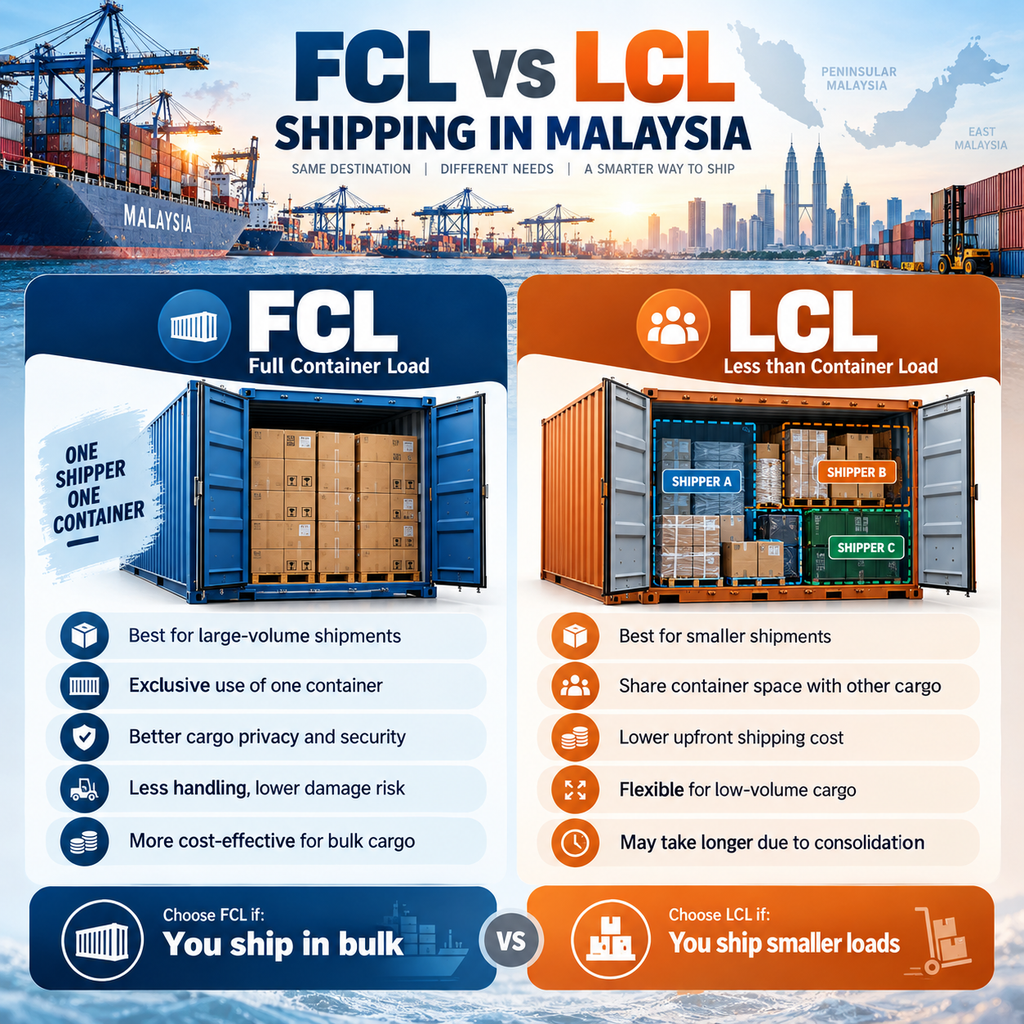
FCL (Full Container Load) means one shipper books and fills an entire container. LCL (Less than Container Load) means your cargo shares a container with other shippers’ goods and is charged by volume, in cubic metres (CBM), or by weight, whichever is greater.
With FCL, the container is sealed at your premises or yard and stays sealed until it reaches the consignee. With LCL, the forwarder’s consolidator combines several small shipments into one container at the origin port and splits them again at destination. Avis Pioneer handles both on our sea freight service, across Port Klang, Penang, Pasir Gudang, Tanjung Pelepas and East Malaysia.
Which is cheaper, FCL or LCL?
LCL is normally cheaper for small volumes and FCL is normally cheaper for large ones. LCL looks cheap per CBM but adds consolidation and deconsolidation fees. FCL has a higher flat rate but spreads it across more cargo, so cost per unit falls as the container fills.
Container capacity gives a useful frame. A 20ft general purpose container holds about 33 m³ and a 40ft about 66 m³ (Mainfreight container specifications); some operators round the 40ft to 67 m³. Practical loadable volume is lower because of pallets, stacking limits and weight distribution. One freight guide puts the FCL crossover for ocean freight at around 15 CBM, but states it depends on rates and lanes (DCL). Treat any CBM figure as a starting point, not a rule.Tip: Ask for both quotes at the same time. At volumes in the mid-teens of CBM or above, an FCL 20ft quote is often close to the LCL total once all local charges are added.
What costs make up FCL and LCL freight charges?
Both modes include ocean freight, origin and destination terminal handling charges (THC), documentation fees and local charges. LCL adds consolidation at origin and deconsolidation at destination, usually priced per CBM or per tonne. FCL adds container-related items such as seal, haulage and any demurrage or detention.
- Ocean freight: a flat rate per container for FCL; a per-CBM or per-tonne rate for LCL, often with a minimum charge.
- THC: charged per container for FCL and per shipment or per CBM for LCL at the port.
- Consolidation / deconsolidation (CFS) fees: LCL only, covering cargo handling at the container freight station.
- Local charges: bill of lading or delivery order fees, customs declaration, inland haulage, and storage if cargo is not collected on time.
Always request an itemised quote. In our experience, the gap between two LCL quotes is more often in the local charges than in the headline ocean rate.
How does transit time and cut-off differ between FCL and LCL?
FCL is generally faster and more predictable, because the container moves straight from origin to vessel to destination. LCL needs time to collect, consolidate and later deconsolidate cargo, and the consolidator sets an earlier cargo cut-off than the vessel’s container cut-off.
Exact transit varies by route, carrier and port congestion, so ask your forwarder for the current sailing schedule rather than relying on a generic number. LCL consolidators also run fixed weekly sailings per lane, so missing a cut-off can mean waiting for the next one.
Is LCL riskier for damage and handling?
Yes, LCL generally carries more handling risk. Your cargo is loaded, unloaded and re-handled at the container freight station, and it shares space with other shippers’ goods. FCL has fewer touchpoints because the container is loaded and sealed once.
To reduce LCL risk, use sturdy export-grade cartons or palletised packing, mark cartons clearly, and avoid sharing with incompatible cargo. Fragile, high-value or odour-sensitive goods are usually better as FCL, even at partial fill. Cargo needing temperature control is a separate case covered by reefer containers on our sea freight page.
How do FCL and LCL affect customs clearance in Malaysia?
FCL usually clears under a single bill of lading, while LCL uses a master bill plus individual house bills for each consignee. Each shipment is still declared separately to the Royal Malaysian Customs Department (JKDM), using the correct HS code, value and import or export form.
In Malaysia, goods are declared on Customs Form K1 for imports and K2 for exports, and these are submitted by a registered customs agent or licensed forwarding agent (DHL Malaysia). For LCL, your goods can only be released after deconsolidation at the CFS, so a problem with one consignee’s cargo may slow the whole container. Our customs brokerage team prepares declarations for both modes. If cargo is not collected immediately, general and bonded warehousing and transportation and distribution can cover storage and last-mile delivery.
FCL vs LCL Malaysia: how do they compare side by side?
FCL suits large, time-sensitive or fragile cargo, while LCL suits small, occasional or testing shipments. The table summarises the main trade-offs; figures are qualitative because rates change by lane and season.
| Factor | FCL | LCL |
|---|---|---|
| Space | Entire container, one shipper | Shared container |
| Pricing basis | Flat rate per container | Per CBM or tonne, often with a minimum |
| Best volume | Mid-to-large loads | Small loads |
| Extra charges | Haulage, seal, demurrage/detention | Consolidation and deconsolidation, CFS handling |
| Transit and cut-off | Faster, more predictable | Slower, earlier cut-off, fixed sailings |
| Damage risk | Lower, fewer touchpoints | Higher, more handling |
| Bill of lading | Usually one | Master plus house bills |
| Customs release | Container-level | After deconsolidation |
How do I decide between FCL and LCL? (step by step)
Compare your total cargo volume and weight with container capacity, then price both options with all local charges included. Choose FCL when the totals are close or when speed and cargo safety matter; choose LCL when volume is clearly small.
- Measure your cargo. Calculate total CBM and gross weight, including packaging and pallets.
- Compare with container capacity. A 20ft holds about 33 CBM and a 40ft about 66 to 67 CBM, with practical loading lower.
- Request itemised quotes. Get FCL and LCL prices covering freight, THC, consolidation, local and customs charges.
- Weigh time and risk. Check the transit, cut-off and how fragile or valuable the goods are.
- Confirm documents and book. Agree Incoterms, prepare invoice and packing list, and book with your forwarder.
Key takeaways
- LCL is usually cheaper for small volumes; FCL wins as cargo fills more of the container.
- The break-even CBM varies by lane, carrier and season, so always compare both quotes.
- A 20ft container holds about 33 CBM and a 40ft about 66 to 67 CBM.
- LCL adds consolidation, deconsolidation and CFS charges.
- FCL is generally faster and lower risk; LCL carries more handling and a fixed cut-off.
- Both modes need K1 or K2 declarations filed by a licensed agent.
Frequently asked questions
What does CBM mean in shipping?Can I ship a partial load as FCL?Is LCL available from Port Klang and other Malaysian ports?Do I need a customs agent for LCL imports?Which is better for first-time importers?
Not sure which fits your cargo? Send us your dimensions, weight and route and our team will price both options. Request a sea freight quote, or call +60 3-5525 5744 or email enquiry@avispioneer.com. Explore our sea freight and vessel chartering services.