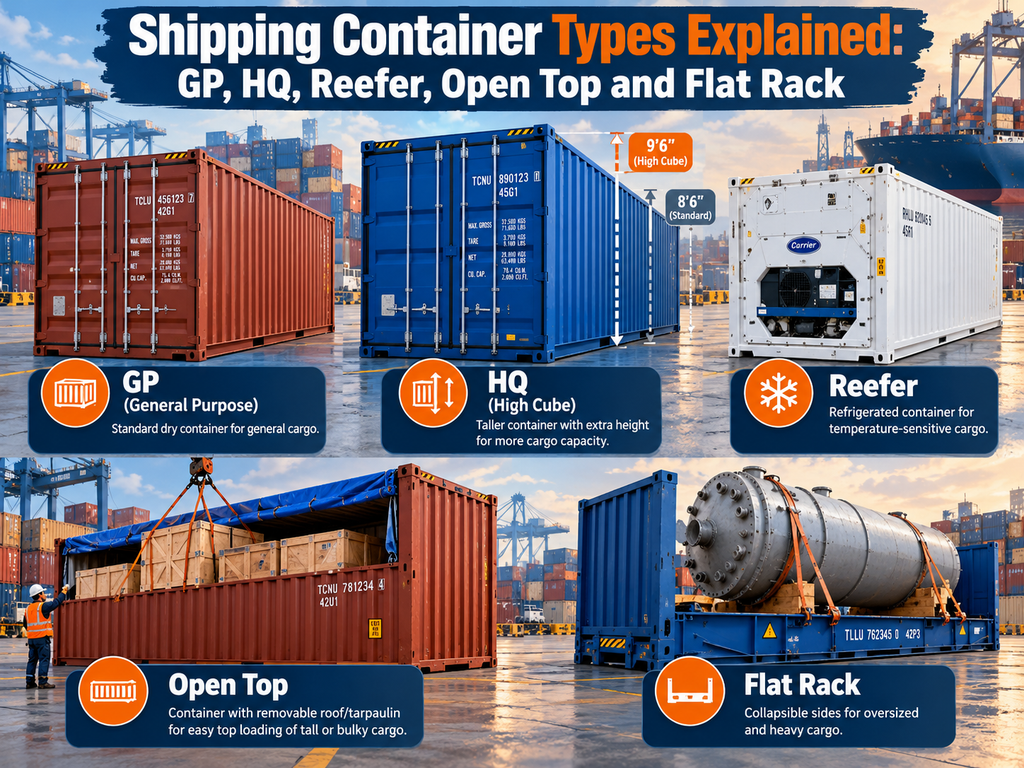
Quick answer: The main container types for sea freight are general purpose (GP), high cube (HQ/HC), reefer, open top, flat rack and containers approved for dangerous goods (DG). Pick by cargo: dry boxed goods go in GP or HQ, chilled or frozen goods in a reefer, and tall or heavy cargo in open top or flat rack. Always confirm exact specifications with your carrier.
What are the main container types for sea freight?
The main container types for sea freight are general purpose (GP) dry containers, high cube (HQ) containers, refrigerated (reefer) containers, open top containers, flat racks and dangerous goods (DG) containers. Each is built for a different cargo profile. Our sea freight and vessel chartering service books all of these out of Malaysian ports.
What size are 20ft and 40ft GP and HQ containers?
A 20ft GP container is roughly 5.9 m long inside with about 33 cubic metres and 21,700 kg payload, while a 40ft GP holds about 66 cubic metres and 26,500 kg. A 40ft HQ (high cube) is about 30 cm taller, giving roughly 76 cubic metres.
GP (also called dry or standard) containers are closed steel boxes with doors at one end. They suit palletised goods, cartons, machinery in crates, furniture and most non-perishable products. A 40HQ is the common choice for light, voluminous cargo such as garments, furniture or packaging, because you run out of space before you hit the weight limit. Dense cargo like tiles or steel often fills a 20ft by weight first.
What is a reefer container and what temperature does it hold?
A reefer is an insulated container with a built-in refrigeration unit that keeps cargo at a set temperature. Standard reefers typically operate from about -30°C to +30°C, according to Maersk, which suits frozen food, chilled produce, pharmaceuticals and some chemicals.
Reefer basics worth knowing:
- Set the carriage temperature to the cargo, not the other way round. Frozen meat is commonly carried at -18°C or colder, while chilled fruit and vegetables need cargo-specific settings that your supplier should specify.
- Pre-cool the cargo. A reefer maintains temperature; it is not designed to cool warm cargo down.
- Reefers need electrical power at the terminal, on the vessel and during trucking, so plan the plug-in and genset arrangements.
- Usable space is smaller than a dry box because of insulation. Typical 40HQ reefer internal size is about 11.58 x 2.28 x 2.53 m with payload near 29,700 kg.
When should I use an open top container?
Use an open top container when cargo is too tall for the doors or must be loaded from above by crane. It has a removable tarpaulin roof instead of a hard one, with the same footprint as a GP box. Typical 20ft open top payload is about 30,000 kg, and about 26,600 kg for 40ft.
Typical cargo includes machinery, steel coils, timber, glass sheets and plant equipment. Internal height is about 2.38 m for a standard open top, but cargo that sticks above the roof bows counts as over-height and needs a booking declaration and sometimes a surcharge.
What is a flat rack and what is OOG cargo?
A flat rack is a container with a floor and collapsible or fixed end walls but no side walls or roof, designed for cargo that is too wide, tall or heavy for a standard box. Cargo that exceeds the box dimensions is called out-of-gauge (OOG) or over-dimensional.
A 20ft flat rack has about 5.6 m of platform length and roughly 31,000 kg payload; a 40ft high cube flat rack carries about 44,000 kg over an 11.65 m platform. Typical flat rack cargo includes generators, transformers, pipes, boats, vehicles and construction equipment.
OOG basics:
- Give exact length, width, height and weight to the carrier at booking, with drawings and lashing points where available.
- Overhanging cargo can take extra slots on the vessel, so freight is quoted on the space blocked, not only the box.
- Lashing, securing and special handling are separate from the base freight. Very large or project cargo may suit vessel chartering instead of liner service.
What is a DG container and what is the IMDG Code?
A DG container carries dangerous goods, such as flammable liquids, corrosives or batteries, packed and declared under the International Maritime Dangerous Goods (IMDG) Code. The IMDG Code is the international rulebook of the International Maritime Organization (IMO), mandatory under SOLAS since 1 January 2004.
In practice DG shipping means classification by UN number and hazard class, compliant packaging, correct marking and labels, a dangerous goods declaration and a container packing certificate signed by whoever controlled the packing. The IMDG Code also sets stowage and segregation rules for incompatible goods. Carriers can refuse or hold undeclared or misdeclared DG, so disclose the full details early.Malaysia note: The Port Klang Authority states that the IMDG Code 2024 Edition has been mandatory at Port Klang since 1 January 2026, based on a Hapag-Lloyd local notice. The notice also sets out updated rules for containers carrying vehicles from 1 July 2026. Check the latest with your forwarder before booking.
How do the container types compare?
The table below compares typical internal dimensions and payload for the common types. Figures are approximate, drawn from Mainfreight and a Hapag-Lloyd-based specification summary, and vary by manufacturer and road weight limits.
| Type | Typical internal size (L x W x H) | Approx. payload | Best for |
|---|---|---|---|
| 20GP | 5.89 x 2.35 x 2.36 m | 21,700 kg | Dense, heavy dry cargo |
| 40GP | 12.05 x 2.35 x 2.36 m | 26,500 kg | General palletised cargo |
| 40HQ | 12.05 x 2.35 x 2.69 m | 26,500 kg | Light, bulky cargo |
| 20 reefer | 5.45 x 2.28 x 2.27 m | 27,575 kg | Frozen and chilled goods |
| 40HQ reefer | 11.58 x 2.28 x 2.53 m | 29,700 kg | Larger chilled volumes |
| 20 open top | 5.90 x 2.35 x 2.38 m | 30,050 kg | Tall or crane-loaded cargo |
| 40 open top | 12.03 x 2.35 x 2.38 m | 26,630 kg | Long machinery, steel |
| 20 flat rack | 5.61 x 2.23 m platform | 31,260 kg | OOG and heavy items |
| 40HQ flat rack | 11.65 x 2.22 m platform | 44,050 kg | Long, heavy OOG cargo |
How do I choose the right container type?
Choose by working through the cargo’s temperature, dimensions, weight and hazard class in that order. Start with the most restrictive property, because it usually decides the equipment. The steps below are the approach we use when planning bookings.
- Check for danger. If the cargo is hazardous, classify it under the IMDG Code and plan for DG booking before anything else.
- Check temperature. If it must stay cold or frozen, book a reefer and confirm the set temperature and power needs.
- Measure the cargo packed. Include pallets and crates. If it fits through the doors of a GP, you are in standard territory; if too tall, consider open top; if too wide or long, a flat rack.
- Weigh it. Compare gross cargo weight with the payload and check road limits for the haulage leg.
- Choose 20ft, 40ft or HQ. Dense cargo suits 20ft, bulky cargo 40HQ, or consider LCL for small volumes.
- Confirm with your forwarder before booking, including surcharges, free time and special handling.
What should I know about containers at Malaysian ports?
Port Klang is Malaysia’s busiest container gateway, and the Port Klang Authority enforces IMDG Code requirements there. Penang, Pasir Gudang, Tanjung Pelepas and East Malaysian ports also handle containers, but equipment availability, reefer plug capacity and OOG handling can differ by terminal.
In our experience at Port Klang, special equipment such as flat racks and open tops is scarcer than GP boxes and usually needs earlier booking. Reefer and DG cargo should be arranged well ahead, since gate-in cut-offs and documentation checks are stricter. Once cargo arrives, customs brokerage, transportation and bonded warehousing keep the container moving after discharge.
Key takeaways
- GP and HQ boxes cover most dry cargo; a 40HQ adds about 30 cm of height.
- Reefers typically run from about -30°C to +30°C and need power throughout the journey.
- Open top suits tall cargo, and flat racks suit OOG or very heavy cargo.
- DG shipments must follow the IMDG Code, with correct declaration, marking and packing certificate.
- Specifications vary by carrier, so confirm before you finalise packing.
- Book special equipment early at Port Klang and other Malaysian ports.
Frequently asked questions
What is the difference between 40GP and 40HQ?Can I ship out-of-gauge cargo in a normal container?Do reefer containers cool warm cargo?Do I need special documents to ship DG?Are the container sizes exact?
Not sure which container fits your cargo? Request a sea freight quote or call us on +60 3-5525 5744, and our team will recommend the right equipment from our sea freight service.