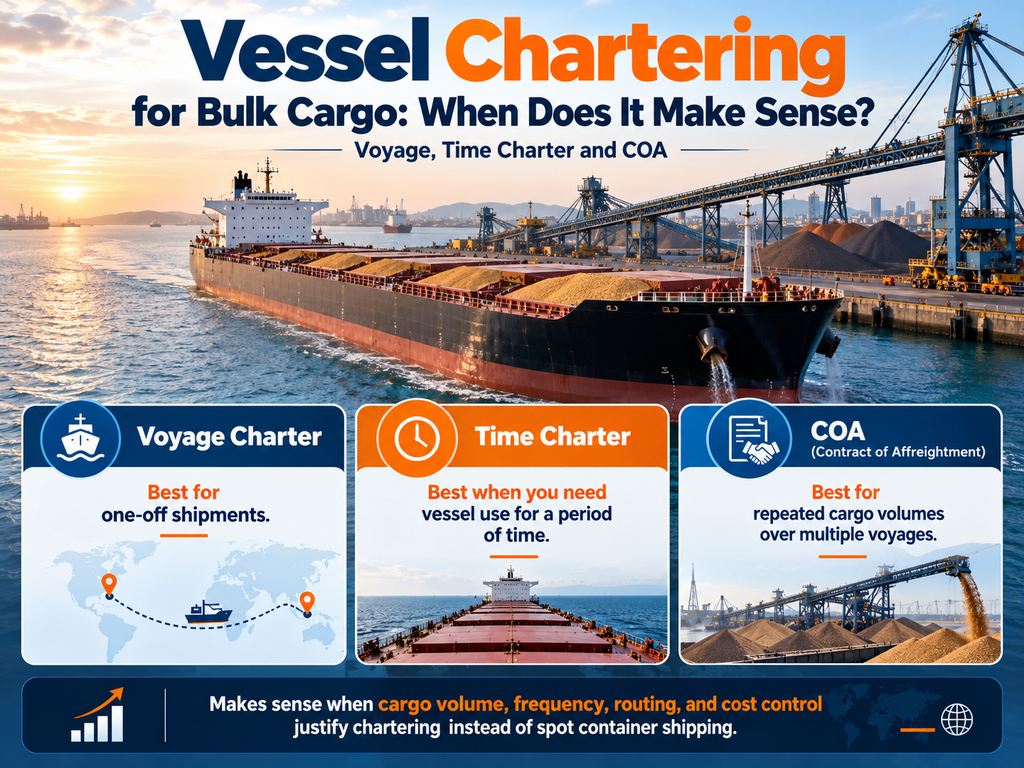
Quick answer: Vessel chartering means hiring a whole ship, or its cargo space, instead of booking slots on a liner schedule. It makes sense for large bulk parcels such as sand, coal, metal scrap or liquid cargoes like POME, PAO and CFAO, or when your timing and ports do not fit a liner service. The main options are voyage charter, time charter, bareboat charter and contract of affreightment.
What is vessel chartering?
Vessel chartering is a contract in which a shipowner makes a ship available to a charterer, either for a single voyage, a period of time, or a series of shipments. Instead of a bill of lading from a liner operator, the terms sit in a charter party. It is the normal way bulk cargo moves worldwide.
For Malaysian importers and exporters, chartering is the alternative to sea freight by container (FCL and LCL). Liner services run on fixed schedules between fixed ports and suit boxed cargo. Chartering suits cargo that is too large, too heavy, too dirty or too awkward to fit that model.
What are the types of charter: voyage, time, bareboat and COA?
There are four main structures. A voyage charter hires a ship for one trip and the owner earns freight. A time charter hires it for a period and the charterer pays hire. A bareboat charter hands over the ship without crew, like a lease. A contract of affreightment (COA) commits to carry agreed volumes over time.
| Type | What you hire | Who crews and manages the ship | Typical fit |
|---|---|---|---|
| Voyage charter | One voyage, port to port, for an agreed cargo | Shipowner | One-off or occasional bulk parcels |
| Time charter | The ship for an agreed period, paid as daily hire | Owner crews and manages; charterer directs trading within agreed limits | Steady, frequent shipments on varying routes |
| Bareboat charter | The ship only, like a lease | Charterer provides crew and pays operating costs | Operators with their own ship management capability |
| Contract of affreightment (COA) | Carriage of agreed total volume in several shipments over a period | Shipowner or carrier chooses the ships | Regular volumes, such as monthly shipments |
Each structure moves cost and risk differently. Under a voyage charter the owner carries most operating costs and quotes a freight rate. Under a time charter the charterer typically takes on bunkers and port costs on top of the hire. Under a bareboat charter the charterer carries nearly everything, which is why it is rare for SME cargo owners. Always confirm cost splits in the written charter party.
When does vessel chartering make sense instead of liner service?
Chartering makes sense when your cargo is too large or unsuitable for containers, when you need a specific sailing date or port pair that liner schedules do not offer, or when you ship large bulk volumes repeatedly. If your cargo fits in containers and your dates are flexible, liner service is usually simpler.
Typical triggers include:
- Volume: a parcel large enough to fill a vessel or a hold, such as sand, coal or aggregates.
- Cargo type: metal scrap, loose bulk and liquid cargoes such as POME, PAO and CFAO that do not travel in standard containers.
- Timing: a project deadline or contract date that a weekly liner call cannot guarantee.
- Route: a loading or discharge point that liner vessels do not serve, including some East Malaysia and coastal locations.
- Repeat shipments: a regular monthly or quarterly tonnage that suits a COA.
What affects the cost of chartering a vessel?
Chartering cost is driven by cargo size, route distance, bunker (fuel) prices, vessel availability, and port time. Delays at berth can add demurrage, which is a daily penalty when loading or discharging takes longer than the agreed laytime. Exact figures vary by market, so request a quotation for your specific cargo and route.
- Cargo size and stowage: larger, well-packed parcels spread vessel costs over more tonnes.
- Route and distance: longer voyages mean more days of hire and more fuel.
- Bunkers: fuel is a major running cost and moves with the market.
- Port charges: port dues, pilotage, towage and terminal handling apply at each call.
- Laytime and demurrage: laytime is the time allowed for loading or discharging. If it is exceeded, demurrage is payable. If you finish early, some contracts pay despatch.
What is a charter party, and what are GENCON and BIMCO?
A charter party is the written contract between shipowner and charterer. It sets the vessel, cargo, ports, freight or hire, laytime, demurrage and liabilities. BIMCO, the Baltic and International Maritime Council, publishes standard forms so parties do not start from a blank page, including GENCON for voyage charters.
BIMCO’s GENCON, first developed in 1922, is described by P&I club West of England as the most widely used voyage charter party in dry bulk. The current version is GENCON 2022, a rewrite of GENCON 1994. Other common forms include NYPE (1993, 2015) for time charters and BARECON 2017 for bareboat charters. Liquid cargoes such as POME, PAO or CFAO move on tanker forms, not GENCON, which is a dry cargo form.
What does a freight forwarder or broker do in a charter?
A forwarder or chartering broker finds suitable vessels, negotiates freight and terms, coordinates the charter party with the owner, and handles port-side arrangements. They connect cargo owners with shipowners and manage practical details so the charterer does not deal with each party alone.
Support typically includes sourcing vessels, advising on charter type, checking laytime terms and coordinating vessel clearance and cargo documents. Avis Pioneer is a licensed Malaysian forwarder and handles these steps under its sea freight and vessel chartering service.
How do you charter a vessel for bulk cargo, step by step?
You define the cargo, request quotes through a forwarder or broker, compare vessels and terms, agree the charter party, plan port operations, then load, ship and discharge while managing laytime. The typical process runs through the six steps below.
- Define the cargo and plan. Confirm cargo type, quantity in tonnes, loading and discharge ports, and the shipping window.
- Request quotations. Ask your forwarder or broker for options from owners and compare freight, vessel age, size and terms.
- Choose the charter type. Decide between voyage, time charter or COA based on your volume and frequency.
- Agree the charter party. Review laytime, demurrage, payment terms and cargo clauses before signing.
- Arrange port and cargo readiness. Prepare cargo, documents and berth, and align with customs brokerage and any trucking to or from the quay.
- Load, sail and discharge. Track the notice of readiness, laytime and any waiting time, then settle freight and any demurrage or despatch.
How does chartering work at Malaysian ports?
Bulk and chartered cargo in Malaysia moves through ports such as Port Klang, Penang, Pasir Gudang, Tanjung Pelepas and East Malaysian ports. Each port has its own berth availability, draft limits and handling facilities, so confirm them with the port or your agent before nominating a vessel.
One local point matters: Malaysia has a cabotage policy under the Merchant Shipping Ordinance 1952. Carriage of goods between Malaysian ports is domestic shipping, which generally requires a Malaysian ship or a Domestic Shipping Licence from the Domestic Shipping Licensing Board. Exemptions for foreign ships change over time, so check the current position before chartering a foreign vessel for a domestic leg. Bulk cargo that stays in storage before onward delivery should also be planned alongside the vessel schedule.
Key takeaways
- Chartering hires a ship or its capacity, instead of a liner slot.
- Voyage charter suits one-off parcels; time charter suits frequent shipments; COA suits regular volumes; bareboat is mainly for experienced operators.
- Choose chartering when cargo volume, type, timing or route do not fit liner service.
- Cost depends on cargo size, route, bunkers, port charges and time at berth.
- Laytime and demurrage terms in the charter party deserve close review.
- GENCON 2022 is BIMCO’s dry-cargo voyage form; liquid cargoes use tanker forms.
Frequently asked questions
What is the difference between a voyage charter and a time charter?What is a contract of affreightment (COA)?What are laytime and demurrage?Can I charter a vessel for POME, PAO or CFAO?Do I need a freight forwarder to charter a vessel?
Planning a bulk shipment that does not fit a liner schedule? Request a vessel chartering quote from Avis Pioneer, or read about our sea freight and vessel chartering service.